| Buy Enid Blyton books | |
| If you grew up with Enid Blyton books, you might be familiar with some of these other children's series... | |
| « Back to Enid Blyton | Home | Email |
|
Detailed reviews
and information: |
The Brains Benton MysteriesDuring a trip to a local secondhand bookshop I was lucky enough to stumble upon two hardback originals from a short series I'd never heard of before. These unexpected delights are The Case of the Counterfeit Coin and The Case of the Roving Rolls, books two and four of a six-book series known as The Brains Benton Mysteries. Curious, I bought them and did some research, and to my surprise found this series to be just as popular in the sixties and seventies as The Three Investigators. The first book, The Case of the Missing Message, was written in 1959 by Charles Spain Verral, and the remaining five in 1960 and 1961 by George Wyatt (although there is a "widespread belief" that the two different authors are actually the same person, and I would certainly agree that the style is consistent).
Brains is tall, lanky and red-haired, wears glasses, and talks like a walking encyclopedia—but he's not your average wimpy nerd, oh no, he's fearless and determined and even the best pitcher in school! Jimmy, on the other hand, is self-described as ordinary: brownish hair, round face, freckles... the sort of person that would go unnoticed in a crowd. I like the way that Jimmy has a newspaper round that often gets in the way of cracking on with the case. This part-time job is integral to the plot in the first two books, but serves to add a feeling of everyday realism in later books. Every detective agency must have a headquarters. Brains Benton's father is Professor Benton of Crestwood College, a brilliant scientist, so he doesn't bat an eyelid when his son takes over the rooms over the garage at the back of the garden. In the horse-and-buggy days of old, this garage was a coach house and so is a good size. Now it's a secret crime lab, and Jimmy normally gains entrance via the alley at the back; when the coast is clear he pushes the third nail in the fourth board from the bottom, activating an intercom, whereby he's prompted to state his name and business in much the same way as the Secret Seven have to state their password. Upon entry to the garage, a staircase unfolds with the clicking of well-oiled machinery and a bluish light winks on... Upstairs, in the rooms over the garage, the crime lab itself is "like a cross between a machine shop, a research laboratory, and the inside of a space ship."
My only other minor quibble with the books is that the author unfortunately relies a little too heavily on cliffhangers-that-aren't-really-cliffhangers, and an over-the-top sense of danger when the possibility of actual physical harm is no more likely than when the Five Find-Outers are nabbed by crooks. Phrases like "it looked like curtains for us" and "we were goners" are a bit much when repeated often enough, and although the villains do seem a little rougher and tougher than many of Blyton's, I doubt that the boys would ever suffer more than a box around the ears. Overall the stories really are very nicely written, and definitely page-turners! And although you might not find the characters as appealing and memorable as Fatty and the Find-Outers, the truth is that these plots are tight and exciting, with no room to spare for having leisurely picnics and sending village policemen on wild goose chases. It's a shame this series is no longer in print. The only copies you can get hold of now are secondhand. I got mine from eBay, and to date have four of the six. Since there are only six titles in the series, and I'm in the process of grabbing all of them, they are listed as follows:
It's apparently quite difficult to get a good matching set of these. The first book I have is an original 1959 Golden Press edition, with dust wrapper. The other three I have are Whitman pictorial hardbacks, but the main difference between them is the size—same height but two different widths! And the wider editions have both orange and sepia internal illustrations, whereas the slimmer editions are in black...
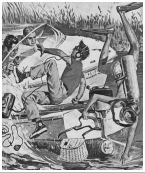
The orange in the Golden Press editions seems a very odd choice, and the sepia in the wide Whitman editions not much better. I think I'd prefer the more standard black. Still, the illustrations themselves are superb, or at least the ones by Hamilton Greene are, in the first two books and apparently the last. All the illustrations on this page are by Hamilton Greene. The ones by Al Schmidt in the other three books are not anywhere near as good, and some are frankly awful.
|
| Copyright © 2004-2013 EnidBlyton.net |